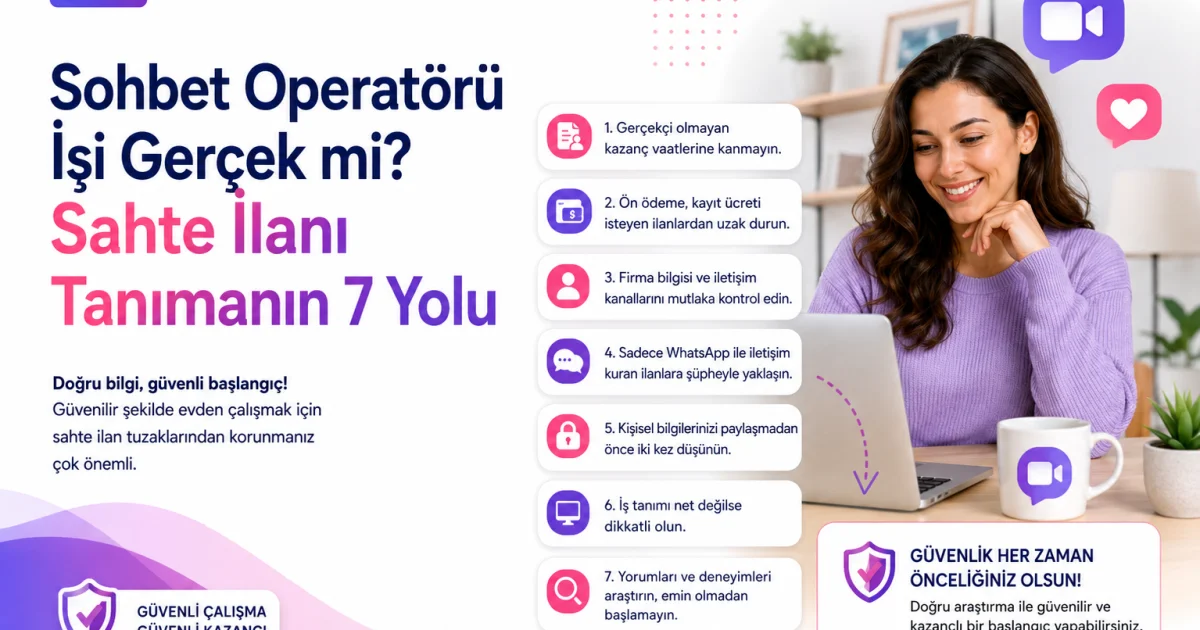
Is Chat Operator Work Real? 7 Ways to Spot a Fake Ad
Video chat operator work is a real job, but fake ads that borrow its name are circulating too. We calmly explain 7 ways to recognise ads that ask for a registration fee, collect ID photos or promise earnings in figures, the steps for verifying an ad, and what you can do if you realise you have been scammed.
The short answer to the question "Is chat operator work real?" is: yes, it is real. Video chat operator work is a genuinely existing way of working, done from home and online. But the second half of that same sentence needs saying too: fake ads that borrow the name of this job are circulating. That is why the real question is not "does such a job exist" but "is the ad in front of me trustworthy".
The good news is this: fake ads give themselves away more than enough. Almost all of them repeat the same handful of behaviours. Once you have learned those behaviours, you can look at an ad that comes your way and decide within a few minutes. Below we first explain clearly what the job actually is, then list the warning signs one by one.
What Is This Job?
Some applicants take these ads for an ordinary office or data entry job. Let us be clear from the very start:
- This is online social chat broadcasting done from home, with the camera on.
- The camera has to be on; however, showing your face is not required. You can protect your privacy through your choice of framing and angle.
- Broadcasters are women aged 18 and over. There is no upper age limit.
- Earnings are not a fixed salary. They are formed from the gifts and tokens sent by viewers, depend on the time spent active, and are not guaranteed.
- This job is not data entry, packaging at home, secretarial work, a call centre role or a text-only messaging job.
- Working hours are flexible; each person sets her own schedule.
- Applying is free; no registration fee, device cost or training payment is requested.
The environment is safe and supervised. Communication is conducted within a framework of respect, and an unwanted conversation can be declined. That said, this job takes effort: without consistency, the habit of being regular and an effort to communicate, results do not come.
7 Ways to Spot a Fake Ad
1. You are asked for a registration or membership fee
A real employer does not ask for money from the person it is going to hire. Every payment request that arrives under a name such as "file opening fee", "membership", "registration in the system" or "priority review" is a sufficient warning on its own. The amount looking small does not change the situation; the issue here is not the sum but the fact that the direction has been reversed. Money flows from the employer to the worker, not the other way around.
2. Money is demanded for a device, program or training
The second common method is to present the payment not as a "fee" but as an "investment": a special camera, a licensed program, a certified training course. Saying it "will be refunded later" or "will be deducted from your first payment" leads to the same door. You do not need to buy a separate device or take paid training for this job. The phone or computer you already have and a decent internet connection are enough.
3. An ID photo or bank details are requested in the very first message
Someone who asks for a photo of your ID, your ID number or your bank details before any process has even begun is a serious warning sign. These documents can lead to transactions being carried out in your name; someone holding an image of your ID can force many doors open without your knowledge. In short, keep your distance from ads that ask you for a photo of your ID, and do not share this information.
4. There is a guaranteed earnings promise with figures attached
Ads that write a particular amount as though it were certain are not realistic. In this work, earnings vary according to the person, the pace and the gifts received. An honest account does not say "you will earn this much"; it explains a method, such as "on the assumption of being active 5-6 days a week, 2-3 hours a day", and states that the outcome is not guaranteed. Be cautious wherever you see a definite figure.
5. The age range is squeezed into a narrow band
Narrowed filters such as "only between 18 and 25" usually describe not a real working condition but a choice of target. It means a group with little experience, one that finds it hard to object, is being sought. In a genuine ad the lower limit is a legal requirement, while there is no upper limit. Women who have established their own routine and have life experience often move forward more comfortably in this work.
6. The ad has no company information or contact address
Fake ads are usually nameless. There is no organisation name, no corporate site, no open channel of communication; everything runs through a single anonymous account. When you ask, no clear answer comes and the subject is changed. If you do not know who you are applying to, you will not know who to reach when a problem arises either.
7. The language of pressure and urgency is used
Expressions such as "the last three places", "if you do not decide today the quota closes" or "reply immediately" are used to stop you from thinking. Urgency is one of the oldest tools of persuasion. A genuine application process does not corner you; it leaves you room to ask questions, to think and to come back a day later.
How Do You Verify a Genuine Ad?
A simple check lasting a few minutes eliminates most of the risk:
- Search the name. Type the name of the advertiser into a search engine. See whether there is a corporate site, published content and an open positions page.
- Look at the contact channel. There should be a corporate site, a working contact form or a registered number. Approach processes that run only through an anonymous account with caution.
- Ask about the direction of payment. Ask openly, "Will any fee be requested from me under any name?" and get the answer in writing.
- Ask about the process. What happens after the application, who explains what, how are earnings formed, when is payment made? A process that cannot be explained clearly is not a good process.
- Do not rush. Wait a day. A genuine ad will still be there tomorrow.
If You Realise You Have Been Scammed
First, stay calm; this situation is not your carelessness but the other side's bad intent. What can be done may be summarised in order as follows:
- Cut off contact and make no further payment. Demands for a "transaction fee" in order to get your money back are a continuation of the same method.
- Keep the evidence: messages, screenshots, the ad itself, account names, receipts and transfer details. Record everything before deleting anything.
- If you have made a payment, inform your bank without delay. Early notification can, in some cases, help to have the transaction stopped.
- To file a complaint you can go to law enforcement or the public prosecutor's office; public institutions also have online reporting channels. It is also worth reporting the ad to the platform where it was published.
- If you are threatened over images or recordings, do not comply with the demand, do not pay, and report the situation to the authorities without delay.
This section is for general information. The circumstances of every case are different; if you need it, consulting a lawyer is the best course.
How Does the Process Work With Us?
Let us describe our own way of working by the same criteria, so that you can compare. Applying is free; you are not asked for money under the name of registration, device or training. No identity document, passport or ID number is requested, and your personal information is kept confidential. The lower age limit is 18 and there is no upper limit. You work with the camera on, but you do not have to show your face. Earnings are not guaranteed; they are formed from gifts and tokens, depend on the time you spend active, and vary from person to person. You set your own working hours; nobody forces you into a schedule.
After you apply, the process moves forward through conversation: we explain how the work is done, how you can protect your privacy and how earnings are formed. You are not asked to hurry your decision, and you can ask all of your questions to the end.
If you would like to assess whether the work suits you, you can take a look at our open positions page and apply to an ad you find suitable.
Frequently Asked Questions
Is video chat operator work a real job?
Yes. It is social chat broadcasting done from home, online and with the camera on. The real issue is telling the genuine job apart from fake ads that use its name; the seven headings above exist for exactly that.
Do I have to pay anything to apply?
No. Applying is free. No registration fee, membership charge, device cost or training payment is requested. If you have come across an ad asking you for a payment under any name, that ad is not trustworthy.
Do I have to show my face?
The camera has to be on, but showing your face is not required. You can work while protecting your privacy through your choices of framing, angle and background.
Will I be asked to share my identity document?
No. No ID photo, ID number or passport is requested; your personal information is kept confidential. We advise you to be cautious towards ads that ask for these documents.
Can I know in advance how much I will earn?
No, because earnings are not fixed. They are formed from gifts and tokens and depend on the time spent active; they vary according to the person, the pace and the gifts received, and are not guaranteed. Treat with suspicion any source that gives you a definite number.